- Free Consultation: 305-758-4900 Tap Here to Call Us




Jeffrey P. Gale, P.A. // The Science of Looming Motion and Looming Threshold in Rear-End Motor Vehicle Collisions


Rear-end collisions account for more than 25 percent of all roadway motor vehicle accidents. The reflexive response is to blame the driver of the approaching vehicle – the one who strikes the vehicle ahead. Florida law reinforces this instinct by creating a rebuttable presumption of fault against the trailing driver. Gulle v. Boggs, 174 So. 2d 26, 27–29 (Fla. 1965) (When “a defendant runs into the rear of a plaintiff’s automobile while the plaintiff is stopped for a traffic light or at an intersection, there is a presumption of negligence of the defendant … . The presumption provides a prima facie case which shifts to the defendant the burden to go forward with the evidence to contradict or rebut the fact presumed. When the defendant produces evidence which fairly and reasonably tends to show that the real fact is not as presumed, then the impact of ‘the presumption is dissipated.’ Whether the ultimate fact has been established must then be decided by the jury from all the evidence before it without the aid of the presumption.”)
That presumption, however, is not absolute. Law enforcement, courts, and personal injury practitioners should resist the temptation to stop their analysis there. Attentive, reasonable drivers can – and sometimes do – collide with the rear of a leading or stationary vehicle in broad daylight through no fault of their own.
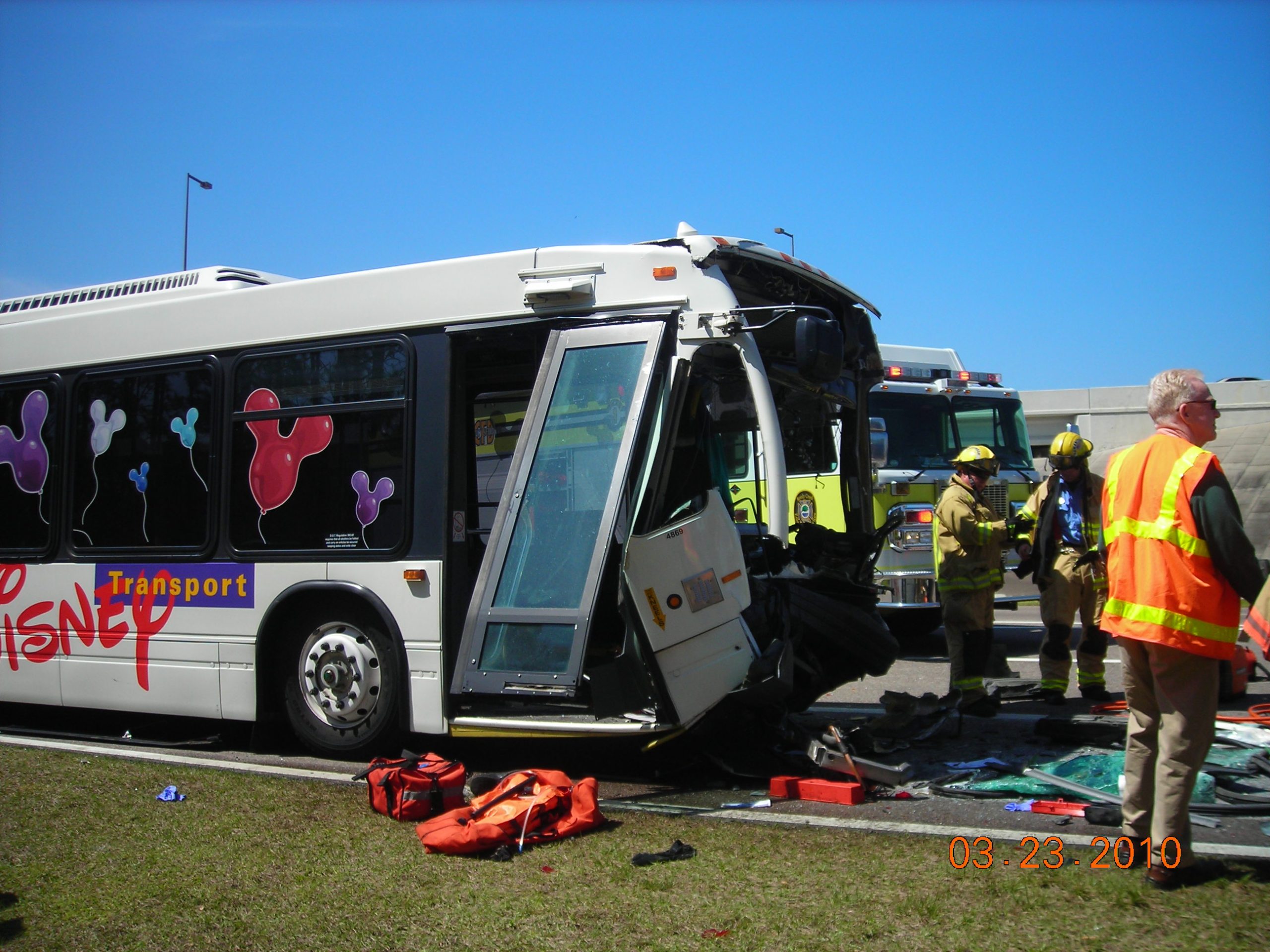
Our firm, together with Attorney Sean Domnick, represented a client in litigation against a motor coach company and its driver arising from precisely such a scenario. Our client was operating his employer’s passenger bus when he struck the rear of a motor coach stopped in a through lane of travel. There was no traffic condition requiring the stop. The motor coach was not disabled; it had not run out of fuel, suffered a mechanical failure, or experienced any emergency. Nevertheless, it remained stationary in a live traffic lane.
Our client approached from behind in the same lane with an unobstructed view beginning approximately 2,500 feet away. There were no vehicles in front of or beside him in any lane. He observed the motor coach at a distance, but did not perceive that it was stopped until he was too close to avoid a collision. The result was catastrophic injuries. (Our client was extricated from his vehicle using the Jaws of Life and airlifted to the hospital.)
We retained multiple experts to address discrete aspects of the case. An engineer testified regarding speeds, distances, and stopping calculations. A trucking expert addressed industry standards and safety practices. Medical experts explained the severity and permanence of our client’s injuries, and an economist quantified past and future economic losses. None of those experts, however, was qualified to explain why a reasonably attentive driver can collide with a stationary vehicle without being negligent.
That explanation lies within the domain of human factors science.
We retained a leading human factors expert to address this critical question. Rather than attempting a technical exposition here, I will briefly describe – at a lay level – the most significant principles at issue: “looming motion and looming threshold.”
In roadway safety, looming motion concerns the human ability to perceive whether an object ahead is moving or stationary. Counterintuitively, a stopped vehicle in the roadway can be among the most difficult hazards to detect, even in broad daylight. At long distances, a stationary vehicle can produce visual information indistinguishable from that of a moving vehicle traveling at the same speed as the observer. In such circumstances, the absence of angular expansion delays recognition that the object ahead represents a hazard. Absent strong visual cues – such as warning triangles, visible occupants outside the vehicle, or signs of roadside activity – the human visual system may not immediately register that a vehicle ahead is not moving.
Closely related is the role of expectation. Human perception is influenced by what a driver reasonably anticipates encountering. Expectation can delay the recognition of danger. In our case, the collision occurred on our client’s regular route, one he had driven daily for more than ten years. The location – near the entrance to a major theme park – was specifically designed to allow commercial passenger vehicles to approach without interruption or delay. In all those years, our client had never encountered a vehicle stopped in this portion of the roadway without an apparent reason.
His reasonable expectation was that traffic would continue flowing smoothly toward the entrance gate located 800 to 1,000 feet ahead. Accordingly, although he saw the motor coach, he did not perceive that it was stationary. The combination of diminished perceptual cues and reasonable expectation created the perfect storm. While the motor coach driver had multiple safe alternatives and made an affirmative choice to stop in a through lane, our client – due to a scientifically explainable failure of perception – was deprived of any meaningful opportunity for cognitive choice.
The concept of “looming distance” is well established in human factors research. Mathematical models can determine the distance at which a stationary hazard should become perceptible to a reasonably attentive driver. Predictably, litigation focuses on the variables—such as vehicle speed—to be used in those calculations. In this case, however, both sides’ engineers agree on the speed at impact.
The “looming threshold” is the point at which the rate of angular expansion becomes sufficient for the human visual system to register that an object ahead is stationary or closing rapidly. This threshold is not subjective guesswork; it is a measurable and well-studied phenomenon grounded in vision science.
The looming threshold occurs later—often dramatically later—when:
- The stopped vehicle presents a large, uniform profile (e.g., a bus or motor coach);
- There are no visual cues indicating distress or abnormality;
- The roadway geometry and traffic flow create an expectation of uninterrupted movement; and
- Lighting and contrast conditions do not emphasize depth or closure.
Until the looming threshold is crossed, a driver may see the vehicle without perceiving it as a hazard.
Our human factors expert opined – using established science – that by the time a reasonably attentive driver would have perceived the motor coach as stopped, there was insufficient time or distance to avoid the collision. Importantly, all evidence supported that our client was, in fact, attentive.
It also bears emphasis that perception and reaction are not synonymous. Even after a hazard is perceived, additional time is required for cognitive processing and physical response.
This discussion is not intended to suggest that trailing drivers are never at fault. Clearly, many rear-end collisions result from inattention or negligence. The takeaway is more modest, but critical: lawyers must be willing to look beyond presumptions and examine the science. When they do, the results can be both professionally rewarding and profoundly meaningful to the client.
The case was tried before an Orlando jury, which awarded nearly $2,000,000 in damages and apportioned fault almost equally between our client and the corporate owner of the stopped motor coach.
**********************
Contact us at 305-758-4900 or by email to learn your legal rights.
Jeffrey P. Gale, P.A. is a South Florida based law firm committed to the judicial system and to representing and obtaining justice for individuals – the poor, the injured, the forgotten, the voiceless, the defenseless and the damned, and to protecting the rights of such people from corporate and government oppression. We do not represent government, corporations or large business interests.
While prompt resolution of your legal matter is our goal, our approach is fundamentally different. Our clients are “people” and not “cases” or “files.” We take the time to build a relationship with our clients, realizing that only through meaningful interaction can we best serve their needs. In this manner, we have been able to best help those requiring legal representation.
DISCLAIMER: This information provided by Jeffrey P. Gale, P.A. is for informational purposes only and is intended to be used as a non-legal guide prior to consultation with an attorney familiar with your specific legal situation. It should not be considered legal advice or counseling. No such legal advice or counseling is either expressly or impliedly intended. This information is not a substitute for the advice or counsel of an attorney. If you require legal advice, you should seek the services of an attorney.